
Storage type comparison
This analysis compares LRC with above-ground tank (AGT), salt cavern (SC), and porous reservoir (PR) using score grading 1–5 on safety, technical, and economic aspects (see table below).
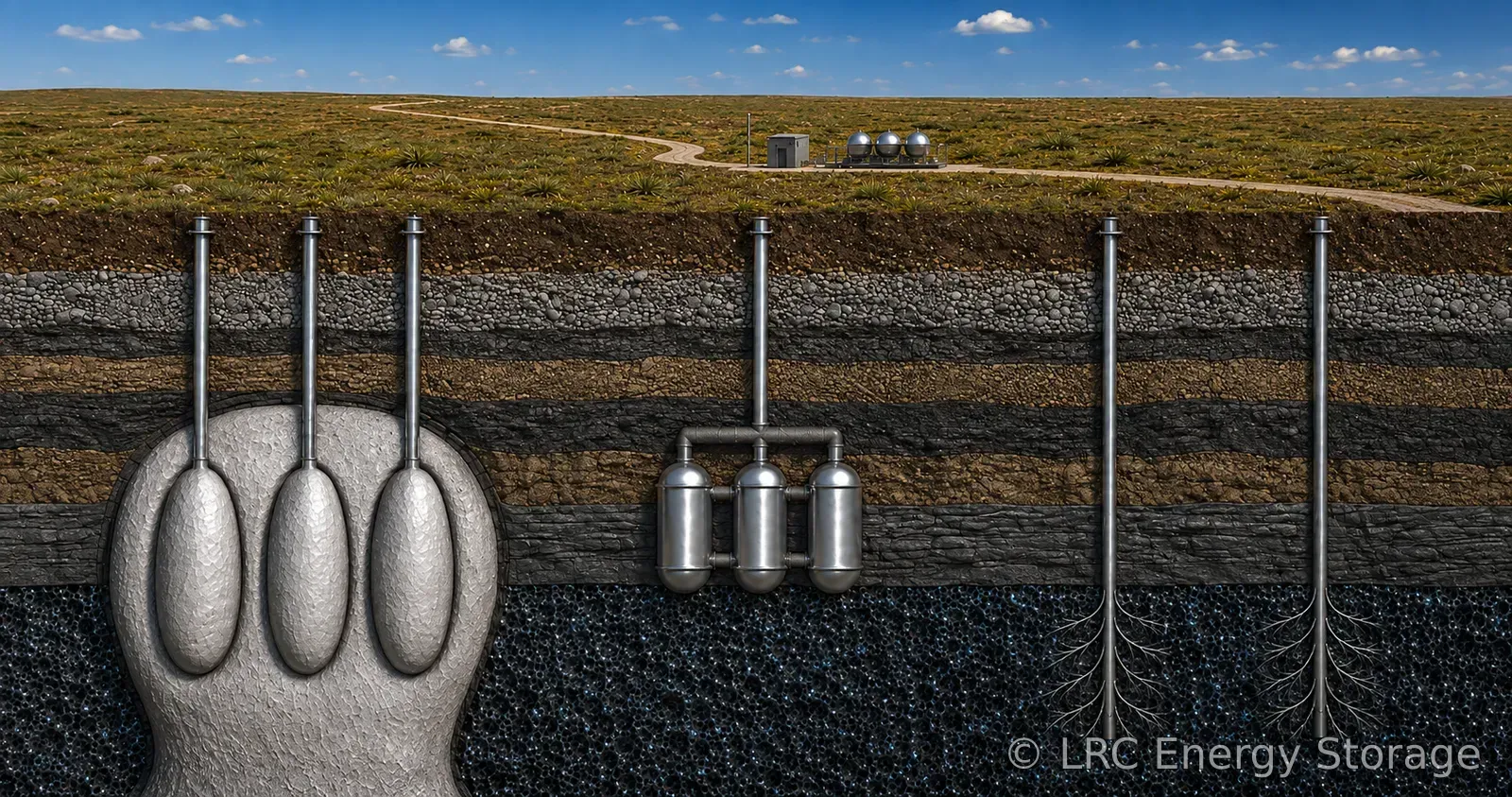
In terms of safety, LRC excels with steel lining that ensures containment tightness and stored gas purity, a combination not matched by SC or PR. While SC is slightly ahead in technology maturity, LRC features numerous compressed air energy storage (CAES) projects worldwide, along with commercial-scale natural gas storage and ongoing hydrogen storage pilot testing, offering a promising pathway forward.
Technically, as the most geologically flexible underground option, LRC stands out with greater maximum pressure and working gas fraction than other underground storage technologies. Although not the largest storage capacity, it can be significantly larger than AGT options.
Economically, LRC is not the most storage cost-competitive underground option. However, it becomes highly appealing when considering that it can be placed close to demand centers, minimizing transportation costs. Access tunnels and depleted mines can be repurposed, and additional LRCs can be built adjacent for scalability, sharing the same main access tunnel. On discharge timescales of several weeks, LRC is capable of stabilizing power grid imbalances.
Although other technologies may excel in specific aspects, LRC demonstrates well-rounded performance across most criteria, achieving the highest overall mean score in this analysis. Different weighting factors can be applied depending on project requirements; however, what can be taken from this comparison is that the LRC stands as the most versatile large-scale energy storage and should be a reliable option to support future power systems.
| Above- ground tank | LRC | Salt cavern | Porous reservoir | |
|---|---|---|---|---|
| Technology maturity | 5 | 3 | 4 | 2 |
| Containment tightness | 5 | 5 | 5 | 4 |
| Gas purity | 5 | 5 | 3 | 2 |
| Land-use efficiency | 1 | 4 | 5 | 5 |
| Geological flexibility | 5 | 3 | 1 | 2 |
| Storage capacity | 1 | 3 | 4 | 5 |
| Maximum pressure | 5 | 4 | 3 | 2 |
| Working gas fraction | 5 | 4 | 3 | 1 |
| Storage cost competitiveness | 1 | 3 | 4 | 5 |
| Infrastructure reusability | 1 | 3 | 3 | 5 |
| Scalability potential | 1 | 3 | 4 | 5 |
| Balancing capability | 1 | 4 | 4 | 3 |
| Mean score | 3.0 | 3.7 | 3.6 | 3.4 |